

An evaporative air cooler cools air naturally — by passing it through water-soaked pads — instead of using a refrigerant compressor like a traditional air conditioner. The result is fresh, humidified cooling at a fraction of the electrical draw of AC. But evaporative cooling has one important limitation: it depends on dry air, which matters a great deal in the Gulf.
Here's how these systems work, the main types, and how to judge whether one suits your space.
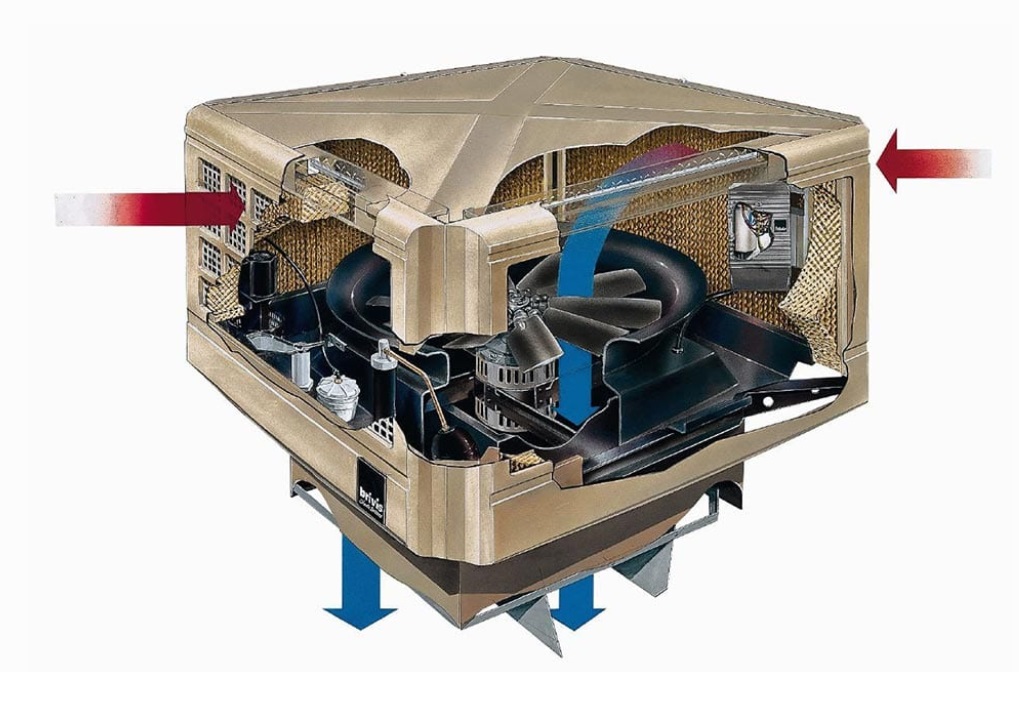
How an Evaporative Air Cooler Works
- A low-wattage water pump circulates water from the tank onto cooling pads (typically honeycomb cellulose or rigid media), soaking them.
- A fan draws outside air through the wet pads.
- As the air passes through, water evaporates and absorbs heat, lowering the air temperature.
- The cooled air is delivered into the space, while warm exhaust air exits through an open window or door.
Because the process relies on evaporation, performance falls as humidity rises — the drier the air, the greater the cooling effect.
Single-Stage vs. Two-Stage Evaporative Cooling
| Type | How it works | Best for |
|---|---|---|
| Single-stage (direct) | Air passes through wet pads and is cooled directly | Dry climates; well-ventilated spaces |
| Two-stage (indirect/direct) | Air is pre-cooled indirectly before direct evaporation | Drier performance in moderate humidity; less moisture added |
Two-stage systems add cost and complexity but deliver cooler air with less humidity gain — worth considering where conditions are less dry.
Types of Evaporative Cooling Equipment
- Portable evaporative air coolers — freestanding units for homes, majlis, workshops, and terraces
- Misting fans — fan plus fine water spray for outdoor seating areas
- Misting systems — fixed high-pressure lines for terraces, cafés, and large outdoor areas
- Window and whole-room coolers — installed units for semi-enclosed spaces
- Ducted/whole-building systems — for warehouses and large industrial spaces
Power Use: What the "10% of AC" Claim Really Means
Evaporative coolers draw far less electricity than air conditioners of similar airflow — often cited at around 10% of the power draw — because they use a pump and fan rather than a compressor. That's a genuine running-cost advantage.
But compare carefully: an evaporative cooler does not deliver the same temperature drop as refrigerated AC, and its effectiveness depends on humidity. The fair comparison is cost per degree of comfort in a suitable climate, not raw capacity.
Where Evaporative Cooling Works Best — and Where It Doesn't
| Condition | Evaporative cooler performance |
|---|---|
| Hot, dry air (low humidity) | Excellent |
| Well-ventilated semi-outdoor space | Good |
| Humid coastal air | Reduced — may add discomfort |
| Sealed, unventilated rooms | Not suitable |
UAE note: evaporative cooling performs best in drier inland conditions and in well-ventilated outdoor or semi-outdoor spaces. In humid coastal areas, or in enclosed event structures, refrigerated spot coolers are usually the more reliable choice.
Sources: